
EMC is not a test at the end. EMC is system design from the very start.
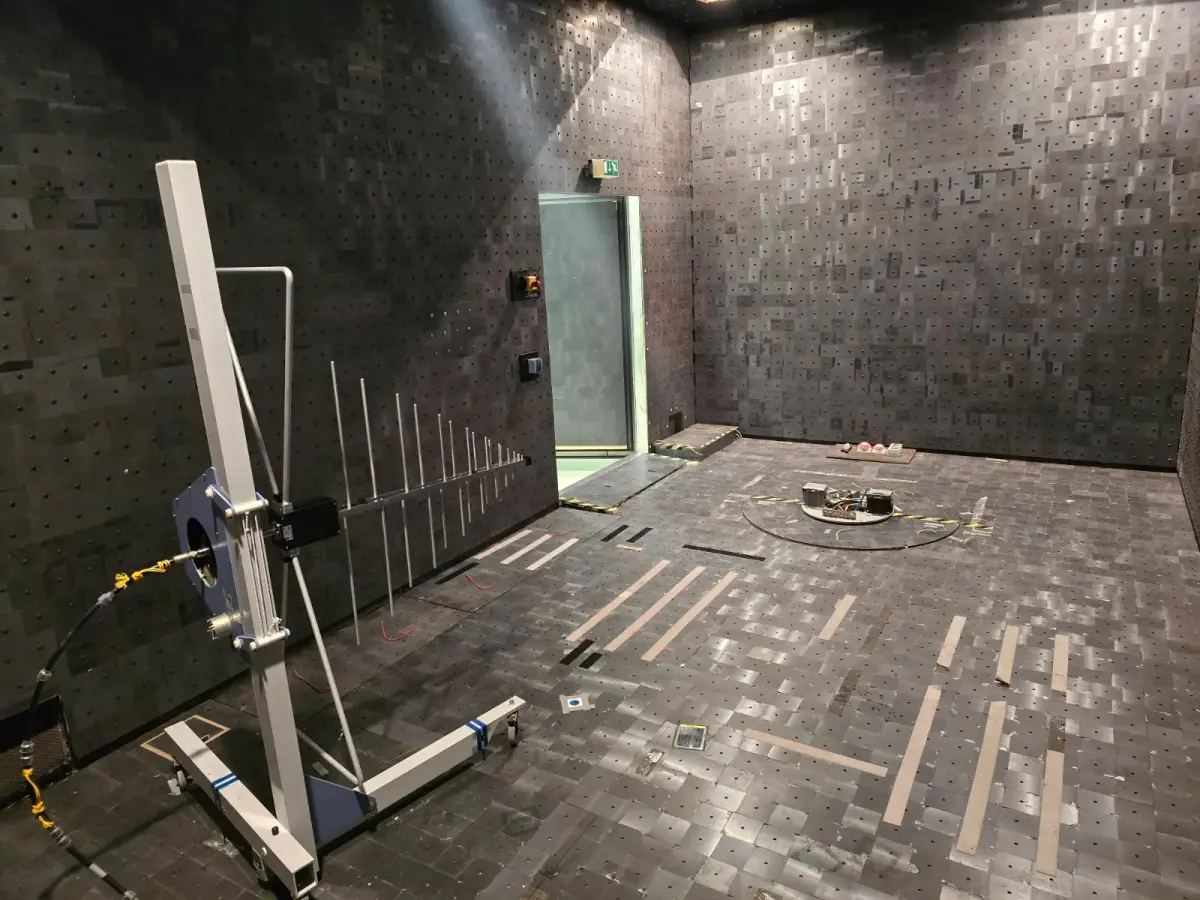
When limit values are exceeded, interference occurs or approval becomes uncertain, it is not only about measured values. SAMD makes EMC risks visible and translates them into measures that work in the real system — with our own fully-anechoic chamber (Harbke site) for measurement throughout development.
- Analysis & fault finding
- Layout, grounding, shielding
- Pre-compliance
- Approval & production readiness
Limit value exceeded, deadline running — and no one knows exactly why.
This is the moment when EMC turns from a side issue into a project risk. Every measure taken on suspicion costs time and money you don't have — and in the end the most expensive surprise looms: failing the accredited test shortly before the start of series production.
Deadline pressure
The test is approachingThe problem only shows up in the test — and time for redesigns is short.
Unclear cause
Symptom instead of sourceLayout, cabling, grounding, filter or software? Without localization, every change becomes an experiment.
Added costs
Expensive re-spinsA failed final test delays series production and drives up costs.
Multiple markets
Many standards, one productCISPR 25, LV 124, OEM standards, FCC, CCC — what fits here is not automatically sufficient elsewhere.
This is exactly where we start.
We replace frantic activity with clarity — first the cause, then the effective measure, validated throughout development in our in-house lab. You go into the test with documented margin.
Locate the cause, optimize precisely, prepare for the test with documented margin.
No action on suspicion: first the cause is located, then the effective measure is verified.
Locate
We find WHERE the interference arises — in the signal path, in grounding, shielding, filter or software, not just at the symptom.
Measure in our in-house lab
Pre-compliance measurement throughout development in the fully-anechoic chamber — reproducible, without waiting for slots at an external lab.
Verify measures
Every measure is immediately re-measured. We don't hope for an effect — we prove it.
Prepare with documented margin
Verifiable documentation and documented margin, so the accredited test passes on the first attempt.
Clarify EMC requirements early.
We clarify early which EMC requirements are relevant for your product, its operating environment and the target market. We assess existing systems by measurement, locate root causes and derive concrete measures for design, layout and integration from them.
The result is not mere measurement documentation, but a sound basis for decisions in the further development.
- Requirements analysis
- Measurement and pre-testing
- Assessment of existing systems
- Interference suppression and optimisation
- Support through to approval
Measuring in our own fully-anechoic chamber.
A fully-anechoic chamber fully absorbs reflections and allows reproducible measurements of emissions and immunity. Because it belongs to SAMD itself, we measure throughout development and iteratively — without waiting for slots at an external lab.
EMC engineering — not an accredited test
In our test centres we carry out development-accompanying EMC measurements. We measure, analyse anomalies and verify optimisation measures before a formal test is due. Our measurements are not accredited. If your product requires formal proof by an accredited test house, we prepare the external test technically and support you in interpreting the results.
EMC services that turn test risks into concrete decisions.
The pillar brings the topic of EMC together — the four modules beneath it address each specific need.
Pre-compliance in our in-house lab
EMC measurement throughout development, before a limit value becomes a release risk.
Learn more Measurement & testingEMC measurement, testing & pre-testing
Measure emissions and immunity, pre-testing and interference source analysis — throughout development in our in-house lab.
Learn more DesignEMC-compliant design & layout
Design reviews, grounding concept, shielding and filtering — EMC from the start instead of retrofitted.
Learn more TroubleshootingEMC troubleshooting & interference suppression
When a product fails the test: fast localization, prioritization, effective measures.
Learn moreWhy customers entrust their EMC to us.
Industries with their own regulatory framework: automotive, railway, medical, industrial
in-house fully-anechoic chamber in Harbke — measuring without external-lab waiting times
Hardware and software development for embedded systems, consulting on electromagnetic compatibility (EMC) and project management in the automotive domain at the Meine site.
Cause in the overall system: layout, grounding, shielding, filter, software
EMC determines approval, deadline and safety.
In a world full of electronics, electromagnetic compatibility (EMC) is steadily gaining importance: it ensures that electronic systems work in their environment without interfering with one another — and it is a prerequisite for the approval of electronic devices.
If EMC requirements are considered too late, there is a risk of delays to market launch, additional costs, production downtime and trade barriers — in safety-critical areas such as medical technology, in extreme cases even danger to people. EMC problems usually arise from unfavorable PCB layout, inadequate shielding, unsuitable cable routing or high switching frequencies. That is precisely why we treat EMC as a system question — from the very start.
For everyone who wants to know exactly.
Well-founded fundamentals from practice — clearly explained and backed by sources.
Immunity vs. emissions
The two sides of EMC — clearly explained.
Read →Measurement technologyEMC measurement methods
Conducted (LISN) vs. radiated (anechoic chamber).
Read →ImmunityESD, Burst & Surge
Test levels, waveforms, coupling (IEC 61000-4-x).
Read →MeasuresShielding & filtering
What actually reduces emissions.
Read →StandardsEMC standards overview
Basic, generic and product standards.
Read →Law & CEEMC Directive 2014/30/EU
Scope, conformity and CE.
Read →Questions & answers on EMC
What is EMC (electromagnetic compatibility)?
Why is EMC so important?
How do EMC problems arise?
How do electromagnetic disturbances arise in the first place?
What effects can disturbances have?
Which measures reduce electromagnetic disturbances?
Which standards and directives are relevant?
What EMC measurement methods are there?
Do I need an accredited lab for pre-compliance?
Which tests does SAMD carry out throughout development?
Our device failed the EMC test — what now?
„Particularly noteworthy is that SAMD Solutions was always on hand whenever problems arose at our end. Their fast and precise way of working has helped us out of complex situations several times — with the grounding concept, with shielding and filtering, with mechanical adjustments as well as with the software.“

Our contribution to the project
- EMC system responsibility
Holistic analysis of components, layout and overall system.
- Cause instead of symptom
Precise fault localization — in our in-house lab with a fully-anechoic chamber.
- Measures with deep impact
From grounding concept and shielding through PCB layout to software.
Related services.
Suspicious measured value, unclear cause, deadline running?
Briefly describe the situation to us — we'll assess the EMC risk and name the next effective steps.
 Meine
Meine Harbke
+49 1511 0988717
Harbke — Gesellschaftssitz & EMV-Labor mit Vollabsorberhalle · Am Glüsig 1C, 39365 Harbke
Meine — Technische Entwicklung (Elektronik & Embedded) · Peiner Straße 16, 38527 Meine
Mo–Fr 07:00–19:00 Uhr