
Conducted emission
What is measured is the disturbance voltage/current that a device emits via its power and signal lines. For this, a line impedance stabilization network (LISN) provides a defined impedance and couples the disturbance signal out to the measuring receiver. In an automotive context (CISPR 25), the conducted measurement typically runs from 150 kHz to 108 MHz, with peak and average detectors.
Radiated emission
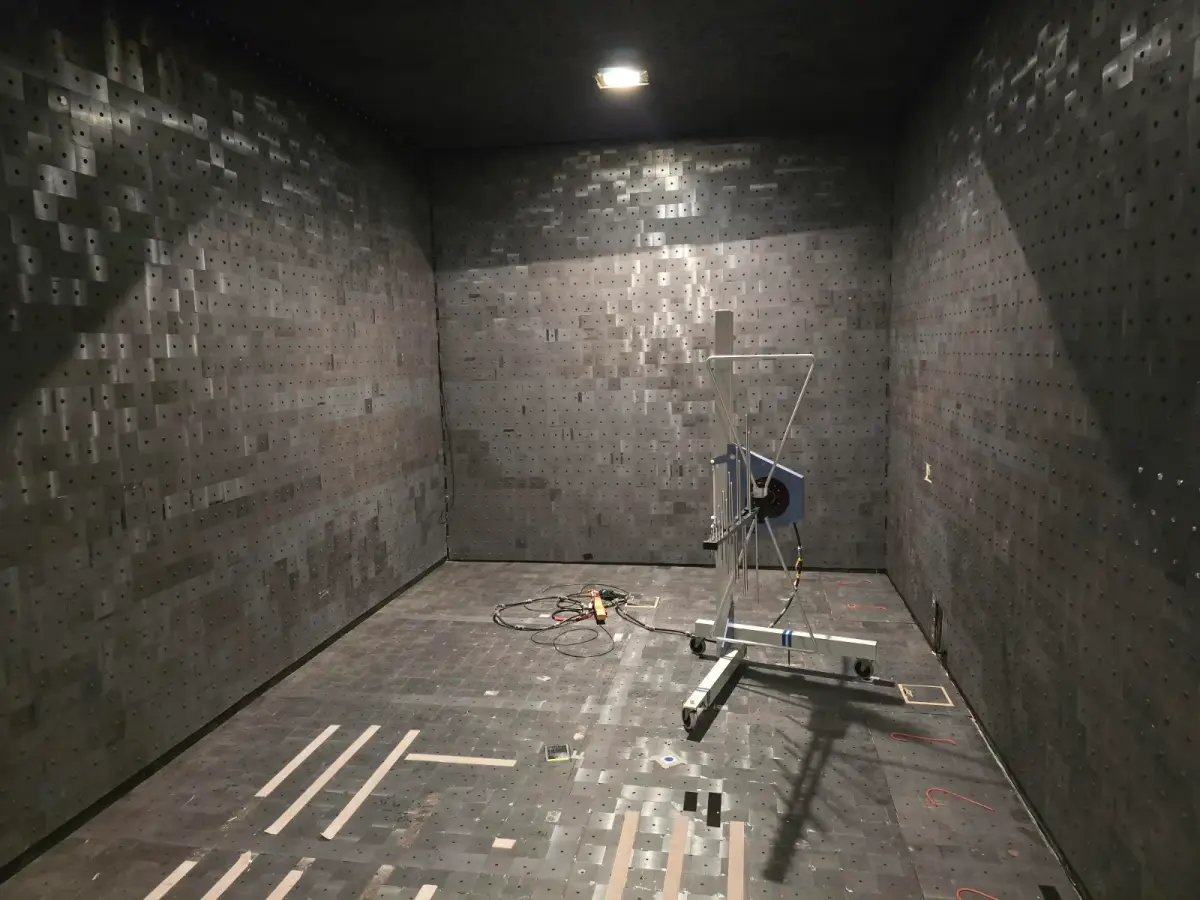
Here the radiated fields are captured with antennas. The reference method is the ALSE method (Absorber Lined Shielded Enclosure) — that is, a shielded chamber lined with absorbers that suppresses reflections. According to CISPR 25, measurement is done at a 1 m measuring distance — closer than many other standards, which increases sensitivity and better represents the real vehicle environment. The frequency range extends up to 2500 MHz.
Why a fully-anechoic chamber?
A fully-anechoic chamber provides reproducible, reflection-free conditions for radiated measurements — the prerequisite for reliably assessing measures. We use it throughout development (pre-compliance), before the expensive accredited test is due.
And immunity?
Besides emission, immunity is tested — ESD, Burst and Surge. More on this in the article ESD, Burst & Surge.
Radiated measurement in the anechoic room.
A low-reflection measurement environment lined with absorbers and equipped with a measuring antenna — this is how radiated fields are captured reproducibly. A plain shielded enclosure would create reflections and distort the result.
Frequently asked questions
What is a LISN?
Do I need an anechoic chamber or is a shielded enclosure enough?
Sources: CISPR 25 — measurement methods, In Compliance Magazine: Automotive EMC, EMC United: CISPR 25. Frequency ranges/distances per CISPR 25; the valid edition of the standard prevails.